
9 min read
Programmable Wallet Authorization: How to Bound an AI Agent
Programmable wallet authorization is the configuration layer that determines whether a transaction initiated by software or an agent is permitted to execute. It works by evaluating a transaction against a defined rule set before any funds move. That rule set typically contains three variables: a value threshold, a reviewer tier, and an expiry window. All three must be satisfied, or the transaction does not proceed.
This matters because 65% of enterprises experienced an AI agent-related security incident in the previous 12 months, per a Cloud Security Alliance survey. Agents acting within wallet permissions that are too broad are the source of most incidents, not agents exceeding their capabilities.
A spending limit is not an agent bound
This is the point most wallet architecture discussions miss. A spending limit tells the system how much a single transaction may move. It says nothing about what happens after that threshold is crossed: who reviews it, what happens if no one does, or how long approval authority stays valid once granted.
If the answer to any of those three questions is "undefined," the agent is not bounded. It operates under a cap, which is different.
The actual constraint is the approval rule set. Threshold, reviewer tier, and expiry window together determine whether a transaction proceeds. Remove any one of them and you have a partial control, not an architecture.
What the three-variable rule set does
The value threshold sets the boundary between autonomous execution and human review. Transactions below the threshold clear automatically. Transactions above it enter an approval queue. This is the variable teams configure most often and think about most carefully.
The reviewer tier defines who can approve transactions at or above the threshold, and whether escalation paths exist for progressively larger amounts. Without this, approval authority is flat: one tier, one set of reviewers, no escalation. In practice, that means a $500 withdrawal and a $500,000 withdrawal land in the same inbox, reviewed by the same people, with the same weight. That is not a governance model.
The expiry window sets the time limit on an approval once granted. This is the variable teams most often skip. The consequence: an approved transaction sits in a queue while market conditions shift, the agent re-requests, a human re-approves, and the cycle repeats with stale authorization still technically valid. With a configurable expiry, an approval that has not executed within the set window is automatically void. Reconfirmation is required before the transaction can dispatch.
Together, these three variables constrain what an agent can do, when it can do it, and under whose authority. A spending limit only addresses the first.
How CoinSend implements each variable
CoinSend's approval architecture covers all three, configured per flow rather than platform-wide.
Custom approval flows let you define reviewer tiers, thresholds, and escalation logic for high-value transactions. The threshold is set per flow. Reviewer tiers are role-structured: sub-account role management gives the main account granular control over each sub-account's roles, and controls each sub-account's login session validity directly. This means the reviewer pool is governed, not just assumed.
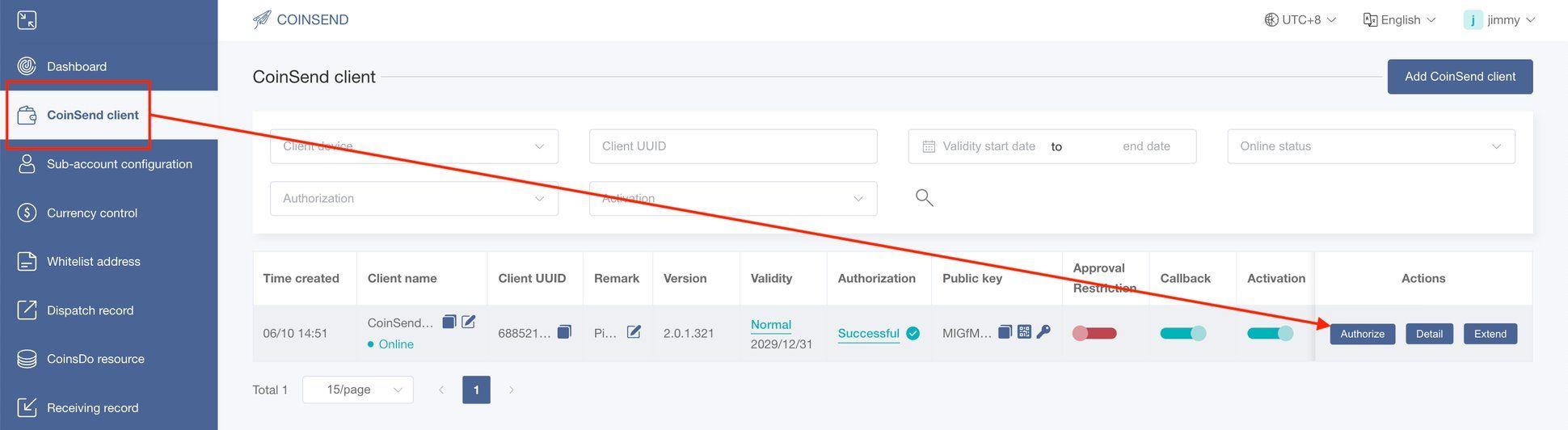
Custom approval with CoinSend
Approval expiry controls attach configurable expiry times to execution approvals, visible per dispatch record. An approved withdrawal that has not moved within the configured window does not execute. The agent cannot retry against a stale approval. It re-enters the queue, which triggers a fresh review cycle.
CoinSign, the approval signing layer within CoinSend, adds RSA/HMAC-SHA256 digital signatures to each authorization. This produces an unforgeable trail of who approved what and when, including the timestamp relative to the expiry window. That trail is the evidence record for any post-incident review.
Without expiry controls, the window problem compounds
A worked scenario, role-anonymous:
The agent initiates a withdrawal above the threshold. A reviewer approves it. The transaction sits in the dispatch queue for 22 minutes because gas fees are elevated and the agent's gas controls are holding it. Market conditions shift. The fee clears. The agent dispatches against the original approval.
The reviewer approved based on conditions that no longer exist. The approval was technically valid because no expiry was configured. The transaction executed correctly by every system measure, and incorrectly by every business judgment.
With a configured expiry window, the same scenario ends differently. The approval lapses at minute 15. The agent cannot dispatch. The human queue receives a new review request, sees updated conditions, and makes a decision with current information.
That gap, between the moment of approval and the moment of execution, is where most agent authorization failures happen. The expiry window is the only control that closes it.
Where CoinSend fits in a broader agent stack
CoinSend is the withdrawal authorization engine inside the [[internal: /en/waas]] platform. Agents that initiate payment flows via API authenticate against CoinSend using asymmetric-signature API authentication. The approval rule set fires for every transaction above the configured threshold. Below the threshold, automated dispatch runs 24/7 without human review.
This is the architecture for [[internal: /en/blog/agent-spending-limits]]: automate low-value, high-frequency withdrawals, and require approval flows for anything above the threshold where human review changes the risk profile.
Gas fee controls add a second dispatch gate. The agent can be configured to hold execution until fees fall within a defined range, preventing unnecessary costs on transactions where timing is not critical.
For exchanges and payment service providers building on egentic wallet infrastructure, the practical question is whether CoinSend's approval flow configuration covers the bounding requirement or whether additional custom logic is needed.
For most cases, configuring threshold, reviewer tiers, and expiry windows inside CoinSend is sufficient. Custom bounding logic becomes relevant when the approval rule set needs to incorporate off-platform signals, such as external risk scores or multi-party consensus from systems outside the wallet stack. TRM Labs notes that autonomous agents create financial crime accountability gaps that responsibility chains must address.
FAQ
What is programmable wallet authorization?
Programmable wallet authorization is a rule-based configuration layer that evaluates whether a transaction is permitted to execute before any funds move. The rule set defines a value threshold, a reviewer tier, and an expiry window. All three must be satisfied for a transaction to proceed.
Why is a spending limit insufficient to bound an AI agent?
A spending limit controls how much a single transaction can move, but says nothing about who reviews transactions above the threshold, how long authorization remains valid once granted, or what happens if no reviewer acts. Agents operating under a cap without a full approval rule set can execute within policy and still cause unintended outcomes.
What does the expiry window control?
The expiry window sets the maximum time between an approval being granted and the transaction executing. If the window lapses, the approval is void and the transaction requires fresh review. This prevents agents from dispatching against stale authorizations when conditions have changed between approval and execution.
How does CoinSend handle the reviewer tier variable?
Sub-account role management in CoinSend gives the main account granular control over each sub-account's roles and session validity. Reviewer tiers are configured within the custom approval flow, and escalation logic can route high-value transactions to progressively senior approval tiers.
Can CoinSend's approval flows handle agent-initiated transactions through the API?
Yes. CoinSend integrates via API with asymmetric-signature authentication. Agent-initiated withdrawal requests pass through the same approval rule set as requests from any other caller. The threshold, reviewer tier, and expiry controls apply regardless of whether the initiating caller is a human or an automated system.